Tile is cold. In a Southern Oregon bathroom on a January morning, it’s very cold, and that’s usually when people start asking about heated floors. Electric floor heat and tile get along great, honestly. But here’s the thing nobody tells you up front.
Pretty much every choice you’ll care about later has to be made before any tile is set, because after that the wire is sealed under thinset and porcelain and it’s staying put.
Want to move the heat over a foot? Too late. Wish the thermostat was by the door? Also too late.

Heated Tile Floors in Bathrooms
So we’ll go through it in the order it comes up. Where the heat goes, where it can’t go, the electrical stuff, and the testing during install.
The planning checklist
| Decide before install | Why it matters |
| Heated area | Cable or mat is sized to it |
| Spots to skip | No heat under vanities, tubs, closets |
| Thermostat location | Wiring and mat layout depend on it |
| Floor sensor spot | Reads the floor temperature |
| Circuit and GFCI | Required for bathroom floor heat |
| Subfloor type | Slabs may need insulation first |
| Resistance tests | Part of the warranty |
Where should the heat actually go?
Only where you’ll stand. Not wall to wall. These systems aren’t laid out that way.
Anything with a closed-in space under it is off limits. Vanities, a tub platform, cabinets, a linen closet. Heat gets trapped under there with nowhere to go, and the cable can overheat, which is why Schluter’s DITRA-HEAT sizing sheet rules all of those out. You also back the cable off from a few things. About 3 inches from the walls. 2 inches from a fixed cabinet. Give a floor drain 6 inches, and a baseboard heater or a heating duct a good 8.
Same idea with a rug, by the way. Throw a thick bath mat over the heated part and the heat just sits under it. Schluter says to keep cable out of spots where a rug or furniture will lie flat on the floor, and Nuheat says the same about furniture that sits flush to the floor.
So picture your own bathroom. Take out the vanity, the tub, the toilet’s footprint, the edges. What’s left is usually the spot where you stand at the sink, the walk over to the shower, and some open floor around the toilet. That’s what gets measured. Not the room. And when you buy the cable, you go close to that number, but never over it, Schluter’s sheet even calls out the mistake of buying enough cable to cover the whole tiled floor.
Mats or cable, and can you cut them?
No cutting. Not with Nuheat mats, anyway. Their install guide is blunt: you can’t cut, shorten, overlap, or cross them, or change them in any way. So if the order’s wrong, it’s wrong.
Got a weird bathroom? Angled wall, a vent in the floor, a little jog around the toilet? Nuheat will build a custom mat if you send in a measured floor plan with all that marked on it. The other route is a loose cable system like DITRA-HEAT. The cable presses into a membrane and you route it however the room needs, around corners and all. Either way, someone has to sit down with a tape measure first.
What does the electrical side need?
A few things, and none of them are tile work.
GFCI comes first. Heating cable in a bathroom floor has to be ground-fault protected under the National Electrical Code. Oregon runs on the 2023 version of that code, in effect here since October 1, 2023. Nuheat makes a Class A GFCI mandatory on every one of its installs, and its thermostats already have one inside.
You’ll want a dedicated circuit, too. Nuheat says its mats should be on their own. Does your panel have the space? Ask an electrician early, not the week the tile setter shows up.
And the thermostat. Think about where your hand actually goes in the morning. Then pick that wall now, because if you’re ordering a custom Nuheat mat, they want the thermostat marked on the floor plan so the lead wire reaches it.
Finally, permits. A new circuit in Oregon generally means an electrical permit. Your city or Josephine County’s building department can tell you what applies to your house before the work starts.
Where does the floor sensor go?
Here’s a part that doesn’t get talked about much. The thermostat doesn’t guess the floor temperature, it reads it through a skinny little sensor wire that’s buried right in the floor with the heat. With a Nuheat mat, that probe gets taped on top, tip sitting between two runs of heating wire. Put it somewhere that feels like the rest of the floor. Not under the rug. Not in a sunny patch by the window, not next to a heat vent, not where a draft comes in under the door. Any of those and the thermostat gets bad information.
It’s a tiny part. It’s also buried for good once the tile is set, so it gets placed with the same care as the cable.
Does the subfloor matter?
Yes, the same way it matters for any tile job, and a little more. Heat or no heat, the floor still has to be solid, flat, and dry, which we cover in Subfloor Preparation for Tile: What Southern Oregon Homes Need Before Tile Goes Down.
Bathroom on a concrete slab? Then there’s one more step to talk about. A slab soaks up warmth from below, so a lot of what you’re paying to heat just disappears down into the concrete. Nuheat recommends putting insulation down first. The floor warms up quicker, and more of the heat goes up toward your feet, which is the whole point.
What has to happen during installation?
Testing, mostly. Nuheat says its mats must be tested before, during and after installation to keep the warranty valid. That means a resistance reading with a meter, checked against the factory number on the tag, and written down in the mat’s resistance log. Skip the log and the warranty is void.
Why three times? Because each stage is a chance to damage a wire. Out of the box, after it’s laid out, and after tile and thinset are on top. If a reading drops off between steps, you want to know before the grout goes in.
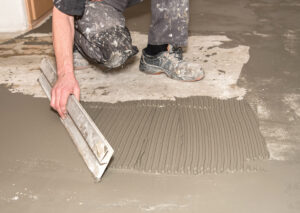
Thinset is the other piece. Nuheat specifies a latex-modified thinset with a 1/4 inch by 1/4 inch square-notch trowel. Then the tile goes on as the tile maker directs. Porcelain, ceramic and stone all work over floor heat, and if you’re still deciding between them, read What Is the Best Tile for Bathroom Floors?
Frequently asked questions
Can heated floor cable go under a vanity?
No. Schluter says to keep it out from under vanities, cabinets and tubs, since trapped heat can overheat the cable.
Do you need a GFCI for a heated bathroom floor?
Yes. The electrical code requires ground-fault protection for floor heating cables in bathrooms.
Can you cut a heating mat to fit?
Not a Nuheat mat. Those can’t be cut or shortened. Odd shapes call for a custom mat or a loose cable system.
Should a concrete slab be insulated first?
Nuheat recommends it. The floor heats faster, and less heat is lost into the concrete.
Planning a bathroom remodel with heated floors in Grants Pass, Medford, Ashland, or elsewhere in Southern Oregon? South Oregon Tile is family-owned and run by Luke McCormick, with more than 15 years of tile work behind it and free estimates. Call 541-450-4657, look through our Bathrooms and Floor Tile services, read How to Choose The Right Grout For Your Bathroom Tile, or contact us online.